
Look, I’ve been covering hero shooters since before “hero shooter” was even a term. I’ve seen modes explode in popularity and vanish into obscurity. But Stadium? The stadium was different. It was Blizzard’s most ambitious swing since they decided to turn a cancelled MMO into a colorful FPS.
Here’s the thing about Overwatch Stadium mode development – it didn’t fail because the idea was bad. It failed because building an MOBA inside a shooter is like trying to teach a gorilla to play chess. It’s impressive as hell when it works, but the amount of work required is absolutely insane.
Quick Answer: Overwatch Stadium mode launched in April 2025 as a third-person, best-of-seven competitive mode where players buy items and equip powers between rounds.
While the mode will receive ongoing balance updates and ranked resets, Blizzard announced in July 2026 that new heroes and maps are no longer in development due to low player engagement, with only 3-6% of daily players in the mode.
What Exactly Is Overwatch Stadium Mode?
Let me break this down for you in plain English because Stadium was confusing as hell when it first dropped. I remember loading into my first match, staring at the Armory screen, and feeling like I’d accidentally opened a completely different game.
Overwatch Stadium mode is a best-of-seven, 5v5 competitive mode where you pick one hero and stick with them for the entire match . No swapping. No counter-picking. You’re locked in, and your only way to adapt is through upgrades .
Between rounds, you enter the Armory and spend “Stadium Cash” on Items – these are your standard power-ups that boost weapons, abilities, or survivability. Items come in Common, Rare, and Epic rarities, and you can equip up to six at a time . Here’s a handy breakdown:
| Feature | How It Works |
| Teams | 5v5 (1 Tank, 2 Damage, 2 Support) |
| Format | Best of seven rounds |
| Hero Lock | No switching; locked for entire match |
| Upgrades | Items (purchased) + Powers (free on odd rounds) |
| Camera | Third-person by default, first-person toggle available |
| Ranks | Seven leagues from Rookie to Legend |
The real game-changers are Powers – transformative modifiers that fundamentally alter how your hero plays. We’re talking Reinhardt spreading lava across the battlefield with Firestrike or Kiriko cloning herself . These are free but permanent. Choose wisely.
The Third-Person Twist
Here’s something I actually appreciated – Stadium defaults to third-person perspective. For the first time in Overwatch history, you could actually see your cosmetics in action . But if you’re like me and third-person shooting feels like playing with oven mitts on, you can toggle back to first-person in the settings .
Overwatch Stadium Mode Release: When Did It Launch?
Overwatch Stadium mode release happened on April 22, 2025 . The timing wasn’t accidental. Marvel Rivals was gaining serious traction with its third-person hero shooter formula, and Deadlock was floating around in the gaming zeitgeist. Stadium felt like Blizzard’s answer – “Oh, you want third-person? We’ll give you third-person with MOBA depth.”
At launch, Stadium supported just 17 heroes . The plan was to add more every season. And to be fair, they did. By the time development stopped, 33 heroes were playable in Stadium .
Season 16 Launch Features
The initial rollout included nine maps using Control, Push, and Clash game modes with special rules . Clash became a best-of-three instead of a best-of-five. Push maps were about half the size. Control was reduced to a single round. Everything was compressed and accelerated.
The ranked system was entirely separate from competitive play . Everyone started at the bottom each season. Getting to Elite rank in any role unlocked exclusive Epic skins – the Season 16 reward was an All-Stars Juno Epic skin .
| 🎯 Mode overview |
Overwatch Stadium — 5v5 best‑of‑seven competitive mode. third‑person default first‑person toggle hero lock Release: 22 Apr 2025 · Status: maintenance (no new heroes/maps after Jul 2026)
|
|---|---|
| 👥 Player share |
~3‑6% of daily active players (Ranked + Unranked combined). Ranked: 3% Unranked: 3% Data from Blizzard internal tracking · June 2026
|
| 🦸 Hero roster |
33 heroes playable · out of 52 total. launch: 17 peak: 33 No further heroes will be added (dev pause).
|
| 🗺️ Maps & modes |
9 maps · 3 core variants: Control (single round) Push (half‑size) Clash (best‑of‑3) No new maps in development.
|
| ⚙️ Armory system |
Items (bought with Stadium Cash) · Powers (free, permanent). Common Rare Epic Powers on odd rounds Up to 6 Items equipped · full refund on sell.
|
| 🏅 Ranked system |
7 leagues · Rookie → Legend. separate ranks per role seasonal reset Group restrictions tighten above Pro tier.
|
| 🎁 Rewards |
Elite rank → Epic skin
Competitive Points
name cards / titles
Seasonal rewards continue despite dev pause.
|
| ⚡ Quick Play |
Best‑of‑5 · faster economy · cross‑play enabled. unranked added Season 18 |
| 🛠️ Patch & stability |
leaver backfill
mercy rule fix
timer reset patched
Ongoing balance updates · no new content.
|
| 🚧 Dev status |
Maintenance mode — balance, rank resets, rewards only. No new heroes · No new maps Team reassigned to future experiments (Perks, 6v6 tests).
|
Why Did Overwatch Stadium Mode Development Stop?
This is the million-dollar question, and honestly, it’s a gut punch for anyone who loved what Stadium represented.
On July 15, 2026, Overwatch game director Aaron Keller dropped the news in a Director’s Take blog post . Let me quote the part that stung:
“While we’ll continue supporting Stadium with seasonal balance updates, rank resets, and rewards, we’re not planning on expanding Stadium with new Heroes or maps.”
The reason? Player data. And the numbers were brutal.
The Numbers That Killed Stadium
According to Blizzard’s internal data collected as of June 28, 2026 :
- Unranked Role Queue 5v5: ~54% of daily players
- Ranked Role Queue 5v5: ~37%
- Unranked Open Queue 6v6: ~19%
- Ranked Open Queue 6v6: ~8%
- Unranked Mystery Heroes 6v6: ~4%
- Stadium Ranked: ~3%
- Stadium Unranked: ~3%
Do the math. Only 3% of daily players were touching the Ranked Stadium. Another 3% played Unranked. Combined, that’s 6% – the same number cited in Polygon’s coverage .
Key Takeaway:
- Stadium captured only 3-6% of Overwatch’s daily player base.
- 5v5 remains the dominant way people play Overwatch
- Even 6v6 modes are more popular than Stadium.
Overwatch Stadium Mode Mechanics: How the Build System Worked
I’ve analyzed hundreds of hero shooter mechanics over my career, and Stadium’s system was genuinely impressive. It just required too much work to maintain.
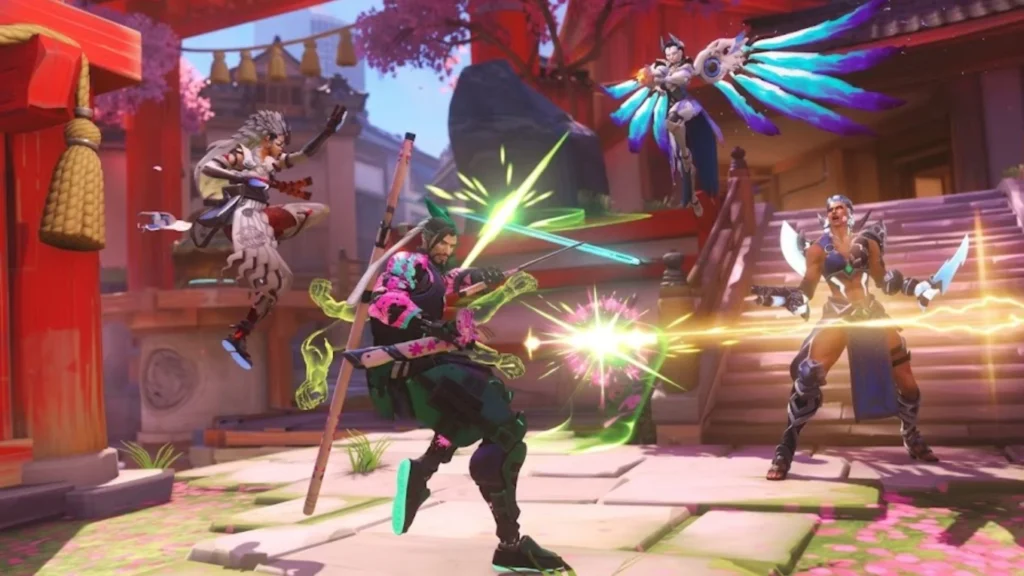
Overwatch Stadium mode mechanics centered on the Armory – a shop system where you’d buy Items between rounds . You started with 3,500 Stadium Cash and earned more based on performance. Better performance = more cash. Falling behind? Bounty targets would appear – eliminating them gave bonus cash .
Items vs. Powers
| Element | Cost | Can Be Removed? | Purpose |
| Items | Stadium Cash | Yes (full refund) | Boost weapons, abilities, survivability |
| Powers | Free | No | Transform abilities completely |
Powers were the real spice. They came on odd rounds (1, 3, 5, 7) and were free but permanent . Once you picked a Power, you were committed.
Hero Build Examples
The development team shared some favorite builds during the launch window :
- Reaper’s Shotgun Sweeper: “Onslaught” Item (+25% ammo, every third shot free but weaker) + “Revolving Ruin” Power (close-range hits boost attack speed). Result? Endless shotgun chaos.
- Ana’s Ultimate Medic: “Eye of Horus” (Nano Boost through walls) + “Our Turn” (Nano Boost affects all allies in line of sight). This turned Ana into a team-wide buff machine.
- Ashe’s B.O.B. Jr. Blast: “B.O.B. Wire Defense” (+300 armor when B.O.B. stops charging) + “B.O.B. Jr.” (50% ult cost, smaller B.O.B.). A mini B.O.B. that comes out more often.
Overwatch Stadium Mode Gameplay: The Good, The Bad, and The Buggy
Overwatch Stadium Mode gameplay was a rollercoaster. When it worked, it was some of the most fun I’ve had in Overwatch in years. When it didn’t work… well, let’s just say I rage-quit a few times.
What Worked
Hero lock actually felt refreshing. Counter-swapping has been a core part of Overwatch forever, but Stadium removed it completely . Instead of switching heroes, you had to adapt your build. Bad matchup? Build to counter instead of swapping.
The shortened modes were genuinely better. Push maps at half-size? Clash at best-of-three? Control in a single round? These felt like improvements. The modes that dragged in normal play suddenly felt tight and tense .
The build variety was insane. I watched a Reaper who never had to reload turn into an absolute menace. I saw Anas become team-wiping nightmares. Every match felt like a puzzle to solve.
What Didn’t Work
The onboarding was terrible. No casual queue initially. Everyone started at the same rank. First match? I was stuck in third-person view, confused about items, while a Soldier 76 with a busted build one-shot our team .
Bugs everywhere. I’m talking matches, not cancelling when someone quits. Mercy rule is not activating even when the screen says it would. The timer resets that messed everything up. Half my matches had someone quit .
The third-person felt wrong for some players. I get why Blizzard did it – better visibility for complex situations. But if you’ve played Overwatch for years in first-person, swapping to third-person is like suddenly driving on the other side of the road. Luckily, you could toggle back .
Key Takeaway:
- Hero lock encouraged creative builds instead of counter-swapping
- Shortened game modes felt better than full versions.
- But terrible onboarding and bugs drove players away.
Overwatch Stadium Mode Changes: The Progression Timeline
Overwatch Stadium Mode changes came fast and frequently during its active development.
Quick Play Addition
One of the biggest community requests was a less stressful version of Stadium . In Season 18, Blizzard delivered with Quick Play Stadium. It was best-of-five instead of best-of-seven, the economy was faster, and cross-play was fully enabled .
Ranked Improvements
Season 18 also brought major ranked changes:
- 10 Quick Play wins required to unlock Competitive
- Dynamic rank system – no more fixed point gains/losses
- Backfill for leavers – less punishment when teammates quit
- Draft Mode – snake draft for hero selection, no mirror matches allowed
The Problem with Hero Implementation
Here’s why Overwatch Stadium mode development couldn’t sustain itself. Every new hero required :
- Entire new Power trees
- Unique upgrade paths
- Balance testing against dozens of existing builds
- Interactions with every Item in the game
The developer effort was massive. When Stadium launched, 17 heroes were playable. They eventually got to 33 . But Season 1’s Jetpack Cat was the last hero to get Stadium-ified . At the time development stopped, nearly 20 heroes were still unavailable in the Stadium.
Overwatch Stadium Mode Roadmap: What’s Next?
The Overwatch Stadium Mode roadmap is… well, it’s not a roadmap anymore. It’s more of a “we’ll keep the lights on” plan.
Continued Support
Blizzard confirmed they’ll maintain Stadium with :
- Seasonal balance updates
- Rank resets
- Rewards
But no new heroes. No new maps. Are the 33 heroes currently playable? That’s your roster for the foreseeable future.
Where the Devs Are Going
Keller confirmed the Stadium team is being redirected to “future plans” and new game format experiments . Those talented developers aren’t gone – they’re just working on other things.
The 6v6 Connection
The Stadium announcement came alongside news about 6v6 experiments . Blizzard is testing “Flex Queue” (1 Tank, 3 Damage, 2 Supports, with one Damage able to swap to Tank) and “Dynamic Queue” (prioritize 2-2-2 but switch to Flex when needed) .
Here’s the kicker: Keller stressed these tests don’t mean the game is switching from 5v5 permanently . They’re experiments. Data gathering. Nothing more.
Key Takeaway:
- Stadium goes into maintenance mode – no new content.
- The dev team was redirected to future projects.
- 6v6 experiments are data-gathering, not permanent changes
Overwatch Stadium Mode Competitive Play: How Ranked Worked
For the competitive grinders out there, Overwatch Stadium Mode competitive play had some unique features :
Rank Structure
Seven leagues from Rookie to Legend, with divisions in each (except Legend). You earned Stadium Points (SP) to climb and only started risking demotion after Novice . Separate ranks per role – you could be Elite on Tank but Platinum on Damage.
The Grind
Seasonal resets meant everyone started at the bottom every season . Win streaks gave bonus points. Reaching Elite for the first time in any role unlocked exclusive skins. At season’s end, you got rewards based on peak rank .
Group Restrictions
To prevent boosting, grouping restrictions escalated as you climbed :
- Below Elite: no restrictions
- Pros: within 15 divisions
- All-Stars: within 10 divisions
- Legends: within 5 divisions
Overwatch Stadium Mode Heroes: Who Made the Cut?
Overwatch Stadium Mode heroes were always a limited selection. At launch: 17 heroes. At peak: 33 heroes. Full roster at the time: 52 heroes . That means nearly 20 heroes were never added to Stadium.
Why Not All Heroes?
Simple answer: development effort. Every hero in the stadium needed :
- Hero-specific Items
- Multiple Power options
- Balance tuning
- Interactions with the entire Item system
This wasn’t just “copy and paste.” This was building an entirely new game for each hero. When Blizzard started rapidly releasing new heroes across the game, Stadium couldn’t keep up .
Overwatch Stadium Mode Strategy: How to Actually Win
I’ve played enough Stadium to know a few things about winning. Here’s what I learned:
Early Game Strategy
Start by building your hero’s strengths. If you’re playing a damage hero, prioritize damage Items. If you’re a tank, build survivability first . Don’t try to be everything at once – specialization wins early rounds.
Adapt to Your Opponent
Since you can’t swap heroes, you have to adapt your build. Enemy has a dive comp? Build against dive. Enemy focusing your supports? Build extra survivability .
Save for Big Items
Don’t blow all your cash early. Saving for Epic Items can swing matches. And remember – you can sell Items for full value, so don’t be afraid to change direction mid-match .
Powers Are Permanent
Once you pick a Power, it’s locked. Consider your matchups before picking. That crazy Reinhardt lava Power might seem fun, but if the enemy has Pharah, maybe you want something else .
Overwatch Stadium Mode Rewards: What You Could Earn
Overwatch Stadium Mode rewards were a major incentive for competitive players :
- Seasonal Epic Skins for reaching Elite rank in any role.
- Competitive Points for Weapon Variants
- Name Cards and Player Titles at season’s end based on peak rank
- Exclusive cosmetics that couldn’t be earned elsewhere
The Season 16 launch reward was the All-Stars Juno Epic skin . Later seasons would have had more, but with development stopping, the reward track is now on autopilot.
How Overwatch Stadium Mode Development Changed the Game
Here’s the thing people don’t talk about enough – Overwatch Stadium mode development didn’t just create a mode. It changed how Overwatch thinks about hero abilities.
The Perks Connection
Remember the Perks system? Where do you choose two ability modifiers mid-match? That was inspired by Stadium . Stadium proved that players enjoyed customizing their heroes in-match, and Blizzard brought that lesson to the core game.
The Experimentation Legacy
Stadium taught Blizzard that Overwatch’s heroes can support far more creativity than the core game usually allows . That lesson – “our heroes can do more” – doesn’t disappear just because the mode isn’t getting new content.
What Could Have Been
I want to be optimistic here. Stadium proved Overwatch can evolve beyond the 5v5 vs 6v6 debate . It experimented with progression, customization, and builds that changed how heroes play. The ideas are good. The execution just… didn’t quite land.
Key Takeaway:
- Stadium inspired the Perks system in core gameplay.
- Proven heroes can support more creative customization
- The ideas are good, but the execution couldn’t sustain itself.
FAQ
Question: Is Overwatch Stadium mode shutting down completely?
Answer: No. Stadium will continue receiving seasonal balance updates, rank resets, and rewards. However, Blizzard confirmed in July 2026 that no new heroes or maps will be added to the mode .
Question: When did the Overwatch Stadium mode release?
Answer: Overwatch Stadium mode launched on April 22, 2025, as part of Season 16 . It was available as a competitive-only mode at launch, with Quick Play Stadium added later.
Question: Why did Blizzard stop developing Overwatch Stadium mode?
Answer: Player engagement was the primary factor. Only 3-6% of daily players used Stadium, while 5v5 modes captured over 90% of the player base. The development cost of adding new heroes was also unsustainable .
Question: How many heroes are in Overwatch Stadium mode?
Answer: The stadium currently supports 33 heroes out of Overwatch’s full roster of 52 . With development stopping, no additional heroes will be added.
Question: Can you play Stadium mode in first person?
Answer: Yes. While Stadium defaults to third-person perspective, you can toggle to first-person in the Options menu under Controls > Stadium > Camera Perspective .
Bottom Line
Overwatch Stadium mode development was Blizzard’s most ambitious hero shooter experiment in years, launching in April 2025 with a third-person MOBA-inspired format that let players build heroes round by round.
The mode captured imaginations briefly but couldn’t maintain player engagement – only 3-6% of daily players stuck with it, leading Blizzard to stop adding new heroes and maps in July 2026. Stadium will remain playable with ongoing balance updates, but its active development days are over.
The real legacy? Stadium’s ideas – particularly the Perks system – have already shaped how Overwatch approaches hero customization.
Read More: Call of Duty Black Ops 7
About the Author