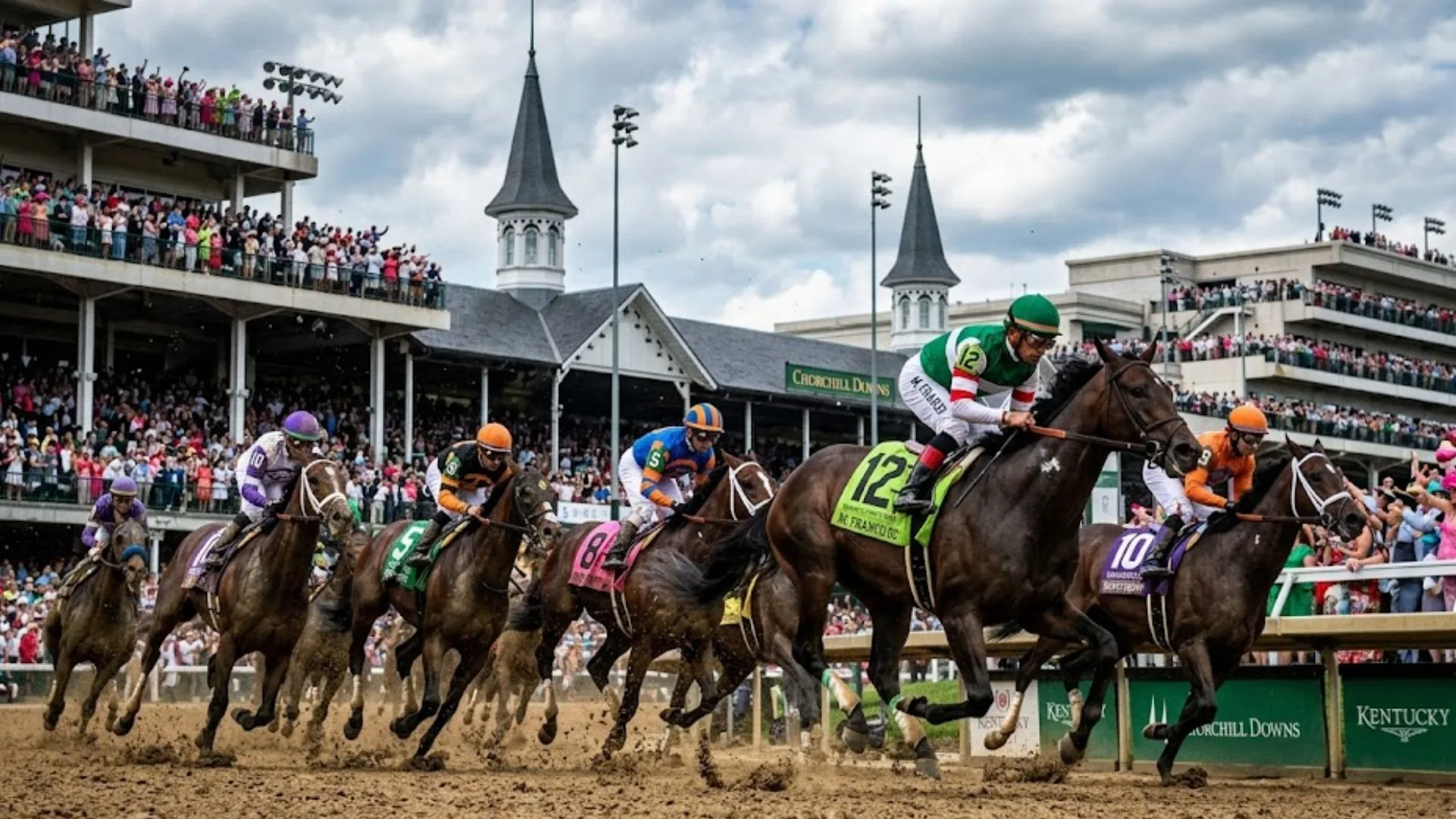
So, what is Kentucky Derby? It’s the biggest, loudest, and fanciest two minutes in sports.
Imagine a car race. Now, replace the cars with 20 thoroughbred horses going 40 miles per hour. Add 150,000 screaming people wearing wild suits and even wilder hats. Sprinkle in a drink called the mint julep. That’s the party.
The Kentucky Derby explained simply: It’s a horse race. But not just any race. It’s the first race in the Triple Crown. That’s a huge deal in horse racing. Only the best three-year-old horses get in. The Kentucky Derby’s meaning goes deeper than speed. It’s about guts, luck, and a little bit of southern magic.
Kentucky Derby history started back in 1875. That’s over 140 years ago. A guy named Meriwether Lewis Clark Jr. (yes, from the famous Lewis and Clark trip) started it. He watched races in Europe and thought, “We need this in America.” He was right.
Today, the Kentucky Derby event is part race, part fashion show, and part giant backyard barbecue. It’s the one day when bankers and farmers stand shoulder to shoulder. Both yell their lungs out for a horse named something silly.
The Kentucky Derby horse race only lasts about 125 seconds. But people prepare for it all year. Trainers lose sleep. Owners spend millions. Jockeys diet down to 115 pounds just to sit on top of a 1,200-pound animal.
So, when is Kentucky Derby? Always. On the first Saturday in May. Rain or shine. Heat wave or cold snap. That date is carved in stone.
Why is the Kentucky Derby famous? Because it’s chaos. Beautiful, organized, loud chaos. A horse named “I’ll Have Another” won in 2012. An 80-1 longshot named Rich Strike (nobody thought he could win) shocked the world in 2022. That’s why we watch.
Let’s break it all down. No fancy words. Just the gritty truth.
Kentucky Derby · Technical Data Sheet
| Official Event Name | Kentucky Derby (Grade I Stakes Race) |
|---|---|
| First Running | 1875 · 150+ consecutive years (longest continuously held sporting event in North America) |
| 2025 Edition | 151st Running Date: Saturday, May 3, 2025 |
| Race Distance | 1 ¼ miles (10 furlongs) ≈ 2,012 meters |
| Surface | Dirt (engineered sand/silt/clay composition — ~82% sand, 16% silt, ≤2% clay) |
| Track Condition (2025) | Sloppy (0.37 inches rain raceday) |
| Qualification System | “Road to the Kentucky Derby” points system. Top 5 finishers in designated preps earn points. 20-horse maximum field + “also eligibles”. |
| Age / Sex Restriction | Only 3‑year‑old Thoroughbreds (one chance per horse) Fillies allowed (3 winners historically: Regret, Genuine Risk, Winning Colors) |
| Weight Assignment | Colts & Geldings: 126 lbs (57.2 kg) Fillies: 121 lbs (55 kg) (includes jockey + tack) |
| Entry / Starting Fees | $25,000 entry + $25,000 starter fee |
| Total Purse (2025) | $5 million USD |
| Winner’s Share | $3.1 million (approx 62% of total purse) |
| Payout breakdown (top 5) | 🥇 $3.1M · 🥈 $1M · 🥉 $500k · 4th $250k · 5th $150k |
| Fastest Winning Time (all-time) | Secretariat – 1:59.40 (1973) Only other sub‑2:00 winner: Monarchos 1:59.97 (2001) |
| 2025 Winning Time | 2:02.31 (winner: Sovereignty) |
| Post Time (TV broadcast) | 6:57 p.m. Eastern Time (first Saturday in May) |
| TV / Streaming | NBC, Peacock, Fubo, NBC Sports app |
| Location | Churchill Downs · 700 Central Ave, Louisville, Kentucky 40208 |
|---|---|
| Main Track Type | Flat dirt oval (historic main strip) |
| Track Circumference | 1 mile (1.6 km) oval |
| Homestretch Length | 1,235 feet (one of the longest homestretches in North American racing) |
| Track Width (general) | 80 feet (front stretch) · 79 feet (back stretch) |
| Starting Gate Width | 120 feet (Derby start zone) |
| Distance from Derby Start to Finish Line | 1,320 feet (¼ mile chute) |
| Dirt Composition (by design) | River sand, silt, clay blend — controlled cushion depth. 2024-2025 updated with ~2,200 tons of new material for extra safety. |
| Turf Course (inner) | 7/8‑mile oval, width ~80 ft (fescue/bluegrass) |
| Total Property Acreage | 147 acres |
| Seating Capacity (Derby Day) | ~150,000 – 170,000 (record 170,513, 2015) 2025 attendance: 147,406 |
| Infield Capacity | General admission up to 80,000+ fans (standing/party area) |
| Trophy Material & Dimensions | 14k plus 18k gold accents; green gold alloy. Height: 22 inches · Weight: ~56 ounces (without jade base) |
| Iconic Twin Spires | Built 1895 · symbol of Churchill Downs |
| Jockey Weight Limit (tack included) | Max 126 lbs (jockey typically ~110-119 lbs) |
| Official Race Grade | Grade I (American Graded Stakes Committee) |
A Quick Trip Back in Time (Kentucky Derby History)
The year was 1875. Ulysses S. Grant was president. The telephone hadn’t been invented yet. But in Louisville, Kentucky, something special was born.
Meriwether Lewis Clark Jr. wanted to create a spectacle. He visited England’s Epsom Derby. He loved it. He came home and built a racetrack on land owned by his uncles. That land became Churchill Downs, the Kentucky Derby home.
The first race had 15 horses. 10,000 people showed up. A horse named Aristides won. The winner got
2,850.Today?Thewinnergetsover
2,850.Today?Thewinnergetsover1.8 million.
For a long time, the race was just a local thing. Then the 1930s hit. A horse named Seabiscuit became a national hero during the Great Depression. People needed hope. Horse racing gave it to them.
By the 1950s, TV came knocking. Cameras showed the beauty. The speed. The crazy hats. Suddenly, everyone wanted to watch.
Kentucky Derby history has dark chapters, too. Horses get hurt. It’s dangerous. In 2019, several horses died at Santa Anita Park, and safety rules got stricter. The Derby now uses safer rails and better drug testing. It’s not perfect. But it’s trying.
The race has survived two world wars. The Great Depression. A pandemic in 2020 (they ran it in September that year). Nothing stops the Derby.
Why? Because it’s tradition. And Americans love tradition.
Where the Magic Happens (Kentucky Derby Location)
The Kentucky Derby location is Louisville. Specifically, 700 Central Avenue. That’s the address of Churchill Downs.
Churchill Downs Kentucky Derby is more than a building. It’s a cathedral of dirt and grass. The most famous feature? The twin spires. Two white peaks that rise above the track. You see them on every TV broadcast. They’ve been there since 1895.
The track itself is one and one-quarter miles. That’s 10 furlongs. That’s 2,000 meters. For a human, that’s a long run. For these horses, it’s a sprint.
The dirt is deep. It’s tilled and watered. When horses run, mud flies. Jockeys get brown faces. The crowd in the first few rows gets splattered. Nobody cares. They just cheer louder.
The infield is where the party animals sit. That’s the grassy space inside the track. For $80, you can stand there. You’ll see people in flip-flops. People are losing bets. People are drinking mint juleps out of souvenir glasses shaped like a horse’s head. It’s chaos. It’s amazing.
The grandstands are for fancy folks. Seats cost thousands. Men wear suits. Women wear million-dollar hats. They sip bourbon. They bet big. They clap politely.
Both groups watch the same race. Both scream the same thing when the horses hit the final stretch: “GO, BABY, GO!”
The Kentucky Derby location smells like hay, horse sweat, bourbon, and fried food. It sounds like a jet engine from the roar. It feels like the ground is shaking. You don’t just watch the Derby. You feel it.
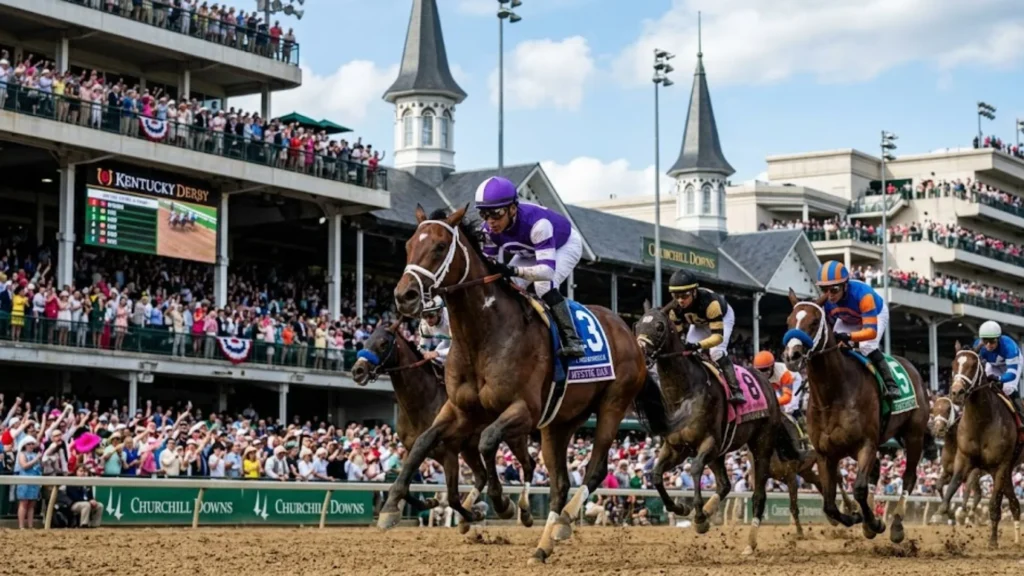
When Does This Thing Happen? (Kentucky Derby Date and Time)
When is Kentucky Derby? First Saturday in May. Period.
Kentucky Derby date and time change a little each year. But the day never moves. May 4th. May 7th. May 2nd. Doesn’t matter. Saturday.
Post time is typically 6:57 PM Eastern Time. That’s when the horses actually break from the gate. But the party starts at 8 AM.
The Kentucky Derby festival events last two full weeks before the race. It’s called the Kentucky Derby Festival. There’s a marathon. A hot air balloon race. A steamboat race on the Ohio River. A giant fireworks show called “Thunder Over Louisville” that’s one of the biggest in North America.
By the time Saturday arrives, Louisville is half-drunk and fully excited.
The race itself is scheduled for late afternoon. TV networks love it. It’s prime time on the East Coast. Late afternoon out West. Families watch together. Grannies place $2 bets. Kids pick horses based on the coolest name (that’s a real strategy).
In 2020, the pandemic pushed the race to September. That felt weird. It was hot. The leaves weren’t changing. But they still ran it. And a horse named Authentic won.
In 2024, the date is May 4th. Mark your calendar. It’s a moving target, but always a Saturday. You can set your watch to the first Saturday in May. That’s the magic.
More Than Just a Race (Kentucky Derby Traditions)
Let’s talk about the weird stuff. The things that make the Kentucky Derby traditions so famous.
The Hats
Women wear giant hats. We’re talking satellite-dish size. Feathers. Flowers. Fake fruit. Sometimes working clocks. (I’m not joking.)
The Kentucky Derby hats tradition started in the 1870s. Rich women wanted to show off. Today, it’s for everyone. You can buy a fancy hat for
50or
50or5,000. Doesn’t matter. Wear something stupid and fun.
The Mint Julep
The Kentucky Derby mint julep drink is the official beverage. What is it? Bourbon. Sugar. Mint. Crushed ice. Served in a fancy glass.
They sell over 120,000 of these on race day. Each costs about $20. The souvenir glass is half the price. People collect them like trophies.
Pro tip: Don’t have more than two. That bourbon will sneak up on you.
The Rose Blanket
The winner gets a blanket of roses. 400 roses sewn into a green cloth. That’s why they call it the “Run for the Roses.”
The blanket weighs about 40 pounds. The groom holds it up while the horse stands still. The horse usually hates it. Makes for great photos.
The Singing
They play “My Old Kentucky Home” before the race. Everyone stands. Women cry. Men take off their hats. It’s the only quiet moment of the whole day. Then the song ends. The screaming starts.
The Mud
If it rains, the track turns to soup. Horses come back black with mud. Jockeys look like monsters. The crowd loves it. A sloppy track is harder to run on. The best horses sometimes lose. The underdogs sometimes win.
These traditions aren’t accidents. They were built over a century. Every one of them makes the race feel bigger than just sports. It feels like history.
The Horses and the Drama (Kentucky Derby Event Breakdown)
The Kentucky Derby event is actually just one race. But 20 horses qualify. Thousands try.
Horses earn points in prep races. The Blue Grass Stakes. The Florida Derby. The Wood Memorial. Win those, and you get an invite. It’s like March Madness, but for horses.
The morning of the race, the Kentucky Derby horses eat breakfast. They get walked. They get brushed until their coats shine. Trainers whisper things in their ears. Do horses understand? Probably not. But the trainers believe it helps.
At 5:00 PM, the horses enter the paddock. That’s the saddling area. Experts look at their muscles. Their sweat. Their poop. (Seriously, horse poop tells you if they’re nervous.) A calm horse is a fast horse.
At 6:51 PM, the horses walk to the starting gate. The gate has 20 stalls. Loading takes three minutes. Some horses don’t want to go in. They rear up. They kick. The crowd holds its breath.
Then the bell rings.
The gates fly open.
The Kentucky Derby horse race begins.
For 125 seconds, nothing else exists. The horses run in a pack. They bump elbows (well, shoulders). Dirt flies into jockeys’ faces. The leader at the half-mile mark usually fades. The closer, the horse that saves energy, comes charging at the end.
The finish line is a wire. Sometimes the winner wins by a nose. Sometimes by 10 lengths. Both are exciting.
In 2009, a horse named Mine That Bird was a 50-1 shot. Nobody thought he could win. He came from dead last and flew past everyone. The announcer lost his mind. The crowd went silent. Then exploded.
That’s the Derby. You can’t predict it. You just hold on.
What’s the Big Deal About Winning? (Kentucky Derby Prize Money)
Kentucky Derby prize money in 2024 is
3milliontotal.Thewinnergetsabout
3milliontotal.The winner gets about 1.86 million. Second place gets
600,000.Thirdgets
600,000.Thirdgets300,000. Even fifth place gets $100,000.
But the real money isn’t the purse. It’s the breeding rights.
A Derby winner becomes a stud. That horse can charge $100,000 per baby. Multiply that by 100 mares a year. You do the math. It’s more money than you’ll ever see.
Why is the Kentucky Derby famous for money? Because it changes lives. Trainers who grew up poor become millionaires. Jockeys who risked their spines can retire early. Owners who bought a horse for $30,000 now own a legend.
Look at Rich Strike in 2022. He wasn’t even in the race until 24 hours before. A spot opened up. His owner paid
30,000toenter.Hewon
30,000toenter.Hewon1.86 million. That’s a 6,000% return in two minutes.
Show me a stock that does that.
But there’s a dark side. Horses sometimes break down. The track is hard. The speed is brutal. A broken leg often means euthanasia. It’s the worst part of the sport. Everyone hates it. No one has a perfect answer.
The Kentucky Derby rules now include a ban on race-day medication (except Lasix for bleeding). Whipping is limited. Vets monitor every horse before and after. It’s not enough. But it’s better than 20 years ago.
How to Watch and What to Know (Kentucky Derby Betting Guide)
Want to watch? How to watch the Kentucky Derby is easy. NBC broadcasts it every year. Streaming on Peacock, too. Also on YouTube TV, Hulu Live, and Fubo. Basically, if you have a TV or a phone, you can see it.
Now, the fun part: Kentucky Derby betting guide for beginners.
Here’s the Kentucky Derby odds explained:
- Win: Your horse comes first. Lowest odds, lowest payout.
- Place: Your horse comes first or second. Easier to win, smaller payout.
- Show: Your horse comes first, second, or third. Even easier, even smaller.
- Exacta: Pick first and second in order. Hard. Big money.
- Trifecta: Pick first, second, third in order. Very hard. Very big money.
- Superfecta: Pick first, second, third, fourth. Insane. Life-changing if you hit.
Odds like “5-1” mean for every.
1youbet,youwin
1youbet,youwin5 plus your dollar back. Odds “20-1” mean you win.
20perdollar.LongshotslikeRichStrike(80−1)pay
20perdollar.LongshotslikeRichStrike(80−1)pay80 per dollar. A
10betonRichStrikepaid
10betonRichStrikepaid800.
Kentucky Derby betting guide rule #1: Only bet what you can lose. #2: Pick a horse with a funny name. #3: Have fun. You’re not buying a house.
The favorite wins only about 30% of the time. Betting is chaos. That’s why it’s fun.
Dress Code and Social Rules (Kentucky Derby Dress Code)
Kentucky Derby dress code is not a real law. Nobody will arrest you. But you will get stared at if you wear jeans.
Ladies: Wear a dress or a suit. Add a hat. The hat should be ridiculous. Think Kentucky Derby hats tradition: big, bold, maybe with a bird on it. Pastel colors work. So does neon. It’s a spring party, not a funeral.
Men: Suit or sport coat. Tie optional but preferred. No tennis shoes. No baseball caps unless it’s for a horse you own (then that’s cool, actually). Seersucker suits are a classic move. Linen is smart. You will sweat. Accept it.
The infield, however, has no rules. Wear a tank top. Wear a costume. Wear nothing but body paint (yes, people do that). The infield is the wild west.
But if you’re in the grandstands or the luxury boxes, follow the Kentucky Derby dress code. Security has turned people away for looking sloppy. True story.
Why so fancy? Because the Derby started as a high-class event. Rich people wanted to show off. Now it’s a tradition. And traditions die hard, especially in the South.
The Winners’ Circle (Kentucky Derby Winners List)
The Kentucky Derby winners list is a who’s who of horse royalty.
- 1875: Aristides (first winner ever)
- 1919: Sir Barton (first Triple Crown winner)
- 1930: Gallant Fox (Triple Crown)
- 1937: War Admiral (Triple Crown)
- 1941: Whirlaway (Triple Crown)
- 1943: Count Fleet (Triple Crown)
- 1946: Assault (Triple Crown)
- 1948: Citation (Triple Crown)
- 1973: Secretariat (still holds the speed record: 1:59.40)
- 1977: Seattle Slew (Triple Crown)
- 1978: Affirmed (last Triple Crown for 37 years)
- 2015: American Pharaoh (ended the drought)
- 2018: Justify (Triple Crown)
- 2022: Rich Strike (80-1 longshot. Biggest upset in 100 years)
- 2023: Mage (15-1 shot, won by one length)
Each winner has a story. Secretariat ran so fast it broke the clock. They had to do a manual time. He’s still the king.
American Pharaoh had a weird spelling. Nobody cared. He was beautiful to watch. Justify was undefeated. Rare thing in racing.
The Kentucky Derby winners’ list is also full of flops. Horses that won the Derby then lost everything else. That’s the pressure. One bad step. One bad day. And you’re just another name.
Frequently Asked Questions (5 Google-Optimized FAQs)
1. What is the Kentucky Derby, and why is it so famous?
The Kentucky Derby is a horse race for three-year-old thoroughbreds held every May in Louisville. It’s famous because it’s the longest continuously run sports event in U.S. history (since 1875). The race only lasts two minutes, but the party lasts two weeks. The hats, the mint juleps, and the “Run for the Roses” nickname make it a cultural icon, not just a sport.
2. How much money does the Kentucky Derby winner get?
The total Kentucky Derby prize money in 2024 is
3million.Thewinnertakeshomeabout
3million.Thewinnertakeshomeabout1.86 million. Second place gets
600,000.Thirdgets
600,000.Thirdgets300,000. The real money, though, comes from breeding fees. A Derby winner can earn millions more by siring future racehorses.
3. What are the most important Kentucky Derby traditions?
The three biggest Kentucky Derby traditions are: (1) Drinking mint juleps (over 120,000 sold each Derby), (2) Wearing giant crazy hats, and (3) Covering the winning horse in a blanket of 400 roses. They also play “My Old Kentucky Home” before the race, and everyone sings along.
4. How can I watch the Kentucky Derby live?
How to watch the Kentucky Derby is simple. NBC broadcasts the race live every year. You can also stream it on Peacock, Hulu Live, YouTube TV, or FuboTV. The post time is usually 6:57 PM Eastern Time on the first Saturday in May. Most sports bars also show it.
5. What is a mint julep, and why is it the Derby drink?
A Kentucky Derby mint julep drink is made of bourbon, fresh mint, sugar, and crushed ice. It’s served in a special glass (often a souvenir). The drink became popular at the Derby in the 1930s because mint grew everywhere in Kentucky, and bourbon was cheap. Now it’s a $20 tradition. It’s strong and sweet. Drink slow.
References:
- Kentucky Derby official website: www.kentuckyderby.com
- Churchill Downs history archives
- National Museum of Racing and Hall of Fame
- NBC Sports Kentucky Derby broadcast records
- Equibase (official horse racing statistics) for the winners’ list and prize money data
Read More: Throne of Glass
About the Author