
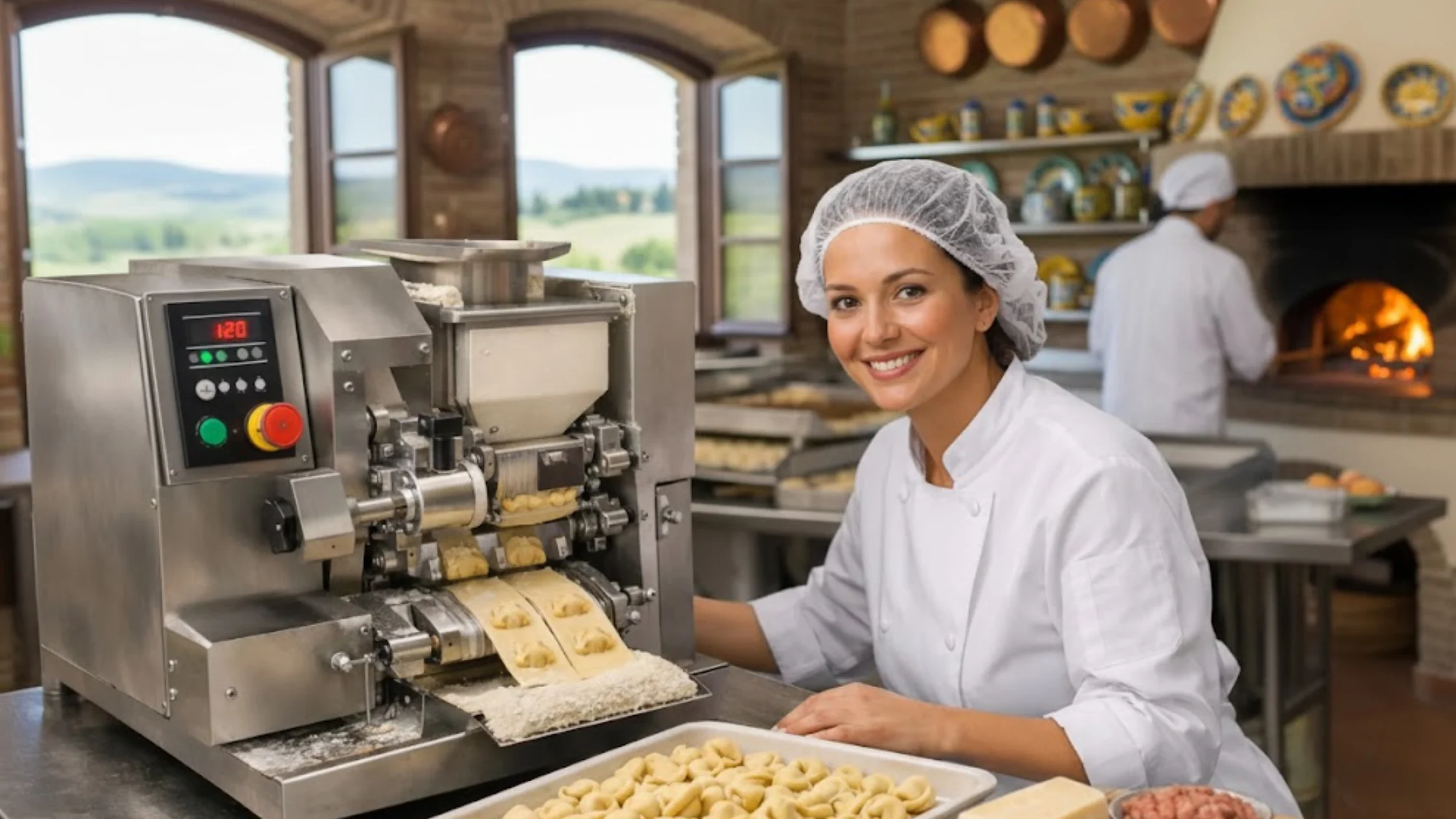
Let’s talk about the tortellinatrice. That’s the magic box. The kitchen wizard. The machine that turns hours of fiddly handwork into minutes of beautiful, consistent pasta. A tortellini-making machine is the secret weapon for anyone serious about tortellini production.
From a small deli to a massive factory, this stuffed pasta machine is a game-changer. It’s not just a gadget. It’s a revolution in a stainless steel case. This guide will crack it open for you. We’ll see how it works, how to use it, and why it might just be the best thing for your kitchen or business.
Top 10 Recommended Tortellinatrice Machines
Specifications and features are compiled from manufacturer datasheets and industry reviews. Always verify with the supplier for your specific needs.
| Machine Model & Type | Key Specifications | Core Features | Best For |
|---|---|---|---|
| Italgi MPF 14/220 Commercial/Medium Industrial |
|
|
Pasta shops, medium-scale production for restaurants, and gourmet food suppliers. |
| Reber 9008N Tortellatrice Small Commercial |
|
|
Start-up delis, small restaurants, farmers’ market vendors, and serious home producers. |
| Zamboni FPF 60 Industrial |
|
|
Large-scale industrial pasta production for national retail distribution. |
| Fama MB 20 Commercial |
|
|
Family-run Italian restaurants, small catering businesses, and artisanal pasta labs. |
| Nuova Era Simonassi BRM 140 Medium Industrial |
|
|
Mid-sized pasta manufacturers and co-packing facilities serving multiple brands. |
| Atlas Nero TRM-200 Commercial Workhorse |
|
|
Businesses looking for a “buy it for life” machine for daily, high-volume shop use. |
| Sirman FUTURA T1 Compact Automatic |
|
|
Modern gourmet restaurants, high-end supermarket fresh pasta departments, and culinary schools. |
| Moffat Inox C-12 Tortellatrice Heavy-Duty Commercial |
|
|
Food production facilities with strict HACCP protocols, and busy central kitchens for hotel chains. |
| Emiliomiti MT-5 Mini Entry-Level Professional |
|
|
Micro-businesses, pop-up food concepts, ambitious home-based businesses, and as a backup machine. |
| Prodotti & Macchine TOR/2 Specialized Industrial |
|
|
Large corporations investing in a complete, customized tortellini production line for maximum automation. |
Important Note: This is an informational comparison. Specifications can change. Output (kg/h) depends heavily on operator skill, dough recipe, and filling type. Always request a live demonstration with your own product before purchasing. Machine names and models are trademarks of their respective manufacturers.
What the Heck is a Tortellinatrice, Anyway?
Think of the classic tortellini. A tiny hat of pasta. A perfect pocket of filling. Making by hand is an art. A slow, loving, maddening art. Your nonna might spend all day at the table. For a restaurant? That’s a payroll nightmare. Enter the tortellinatrice machine.
At its heart, it’s an automatic tortellini machine. It does the job of a skilled pasta sfoglina, but faster. And without ever needing a coffee break. It takes a sheet of dough, deposits a precise dollop of filling, cuts, shapes, and seals those little rings all in one fluid motion. Poof. A tortellini and ravioli machine sibling, but专门 for that iconic navel-shaped pasta.
These machines come in all sizes. A small commercial tortellini machine might fit on a countertop, churning out 20 pounds an hour for your fresh pasta shop. An industrial tortellini machine is a behemoth, a production line monster that can fill supermarket shelves. Whether you call it a tortellini forming machine or a filled pasta machine, the goal is the same: perfect pasta, fast.
The Guts of the Thing: How a Tortellini Machine Actually Works
The magic isn’t magic. It’s beautiful, simple engineering. Understanding how a tortellini machine works is key to using one well. It’s a dance in three acts.
First, the dough. You feed in a sheet of fresh pasta. The tortellini production machine has rollers to guide it. You set the dough thickness settings. It is crucial. Too thick, and it won’t seal. Too thin, and it’ll burst. You get this by feel, fast.
Second, the filling. It sits in a hopper, a big funnel on top. A piston or pump pushes it down through a nozzle. You control the portion. A tiny twist for a delicate cheese filling. A bigger push for a meaty one. It is your filling adjustment. Get it wrong, and you have blowouts or sad, empty pasta.
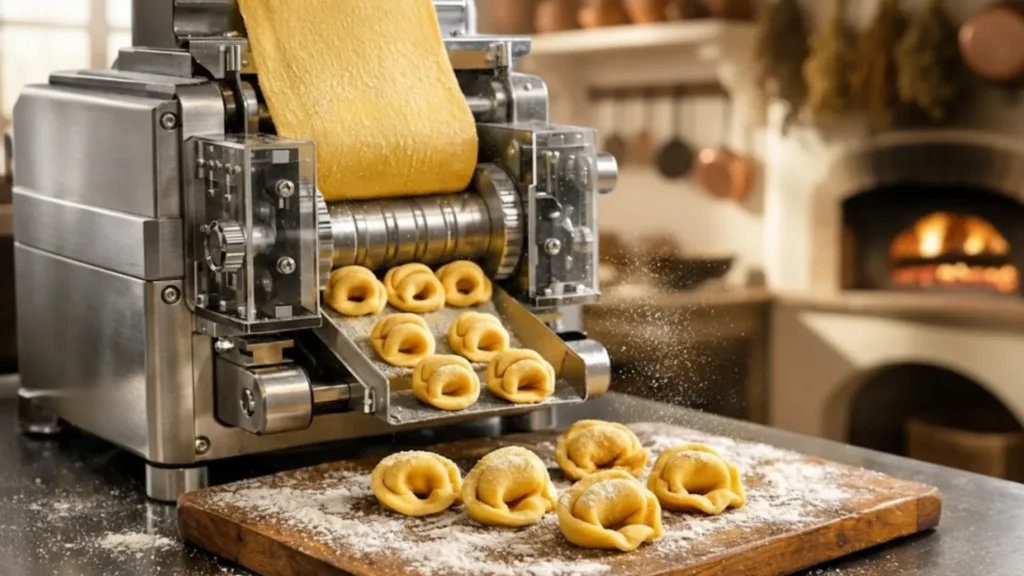
Third, the shaping. It is the cool part. The machine lays the filling on the dough sheet. A cutter comes down—chunk—and stamps out a square or circle, the filling. Then, the mechanical fingers. Little metal claws that fold the pasta over the filling, pinch it shut, and wrap it around a finger-like rod to create that classic ring shape. It’s hypnotic to watch.
- The dough sheet rides in.
- Plop goes the filling.
- Stamp goes the cutter.
- Fold, pinch, wrap the fingers.
- Out drops a perfect little tortellini.
That’s the core of any fresh pasta machine for tortellini. Speed and precision, over and over.
Big, Bigger, Beastly: Picking Your Tortellini Machine Type
Not all machines are the same. Picking the right one means knowing your needs. Let’s break them down.
The Small Commercial Tortellini Machine. It is the workhorse for a restaurant, boutique pasta shop, or farmers’ market vendor. It’s about the size of a large microwave. You might feed dough sheets by hand. It’s relatively simple. You’ll learn its quirks. The hopper holds a few kilos of filling. It’s perfect for small-batch, high-quality production. This is where most people start.
The Industrial Tortellini Machine. It is another animal. It’s often part of a full line. One machine rolls the dough. Another feeds it seamlessly into the tortellini forming machine. Filling is pumped from a massive vat. The output is staggering—hundreds of pounds per hour.
These are for big brands. They have complex controls, automated cleaning systems, and a price tag that will make your eyes water. But if you need to supply a chain of grocery stores, this is your only option.
Then there’s versatility. Many machines are combo units. A tortellini and cappelletti machine can do both shapes with a quick change of the forming head. The same goes for a tortellini and ravioli machine. This is smart buying. One machine, multiple products. It’s a no-brainer for a business wanting a flexible menu.
Think about:
- Space: How much room do you have?
- Output: How many pounds do you need per day?
- Flexibility: Do you need to make ravioli, too?
- Budget: This is a big one.
Getting Your Hands Dirty: How to Use a Tortellini Making Machine
Okay, you’ve got the machine. Now what? The tortellini machine setup steps are your bible. Skip one, and you’ll have a bad time. Let’s walk through it.
First, assembly. Clean and dry all parts. Attach the right forming head for tortellini. Lube the moving parts with food-grade oil if your manual says so. This isn’t optional. It’s like stretching before a run.
Second, the dough. It is 90% of the battle. You need a sturdy, elastic dough. Usually, semolina and water, maybe some eggs. It must be perfectly rested. Not too sticky, not too dry. You’ll roll it to a specific thickness—that’s your first dough thickness setting on the sheeter or the machine itself. Feed it in smoothly. Jerky feeds make ugly pasta.
Third, the filling. It must be the right consistency. Smooth, but firm. No chunks that can clog the nozzle. Think ricotta mixed with herbs, not a coarse pork ragù. Load it into the hopper. Do an initial filling adjustment. Run a few test pieces. Are they full? Are they sealing? Adjust. Test again. It is the tuning process.
Common tortellini machine sealing problems? Usually, it’s the dough. Too dry, and the edges won’t stick. A quick spritz of water on the dough sheet can help. Too wet, and it gums up the cutter. Or the filling is too moist, leaking out and breaking the seal. It’s a balancing act.
A quick tortellini machine troubleshooting guide in your head:
- Pasta not sealing? Check dough moisture.
- Filling oozing? Thicken your filling or reduce portion size.
- Machine jamming? Dough too thick, or you’re feeding too fast.
- Shape looks wrong? Check that the forming head is locked in correctly.
It’s not plug-and-play. It’s learn-and-earn.
Keeping the Beast Happy: Cleaning and Maintenance
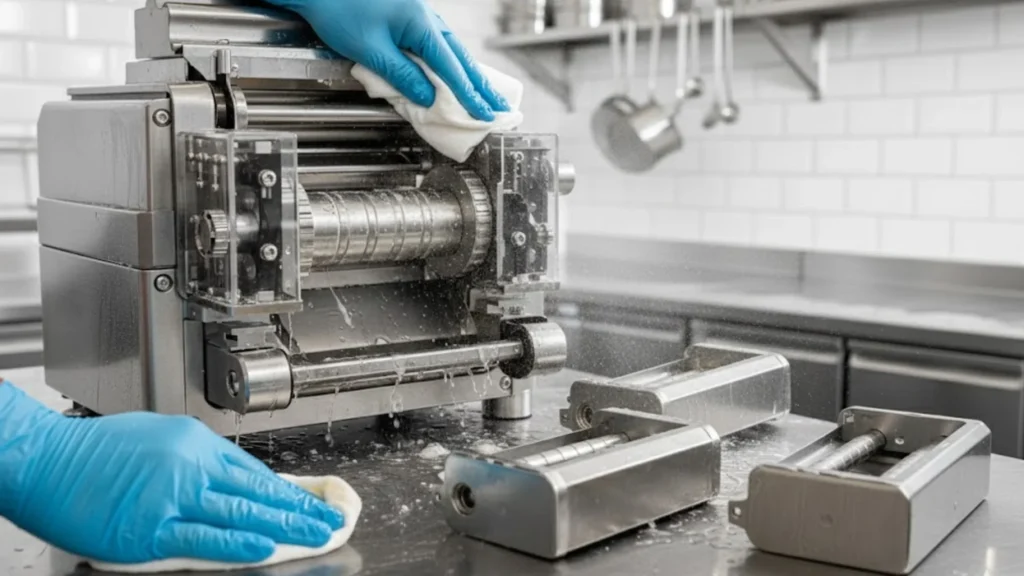
A dirty machine is a dead machine. Filling dries like concrete. Dough turns into a rock. You must clean it every single time you use it. The tortellini machine cleaning guide in your manual is law.
Start simple. Unplug the thing. Always. Then disassemble. Take off the hopper, the nozzle, the forming head, and the cutter. Soak the parts in warm, soapy water. Never use abrasive scrubbers on precision parts. A soft brush is your best friend. Dry everything thoroughly. Water leads to rust. Rust leads to broken machines and sad faces.
Maintenance is bigger. It is your tortellini machine maintenance checklist.
- Weekly: Check all bolts and screws. Are they tight? Vibration loosens them.
- Monthly: Inspect gears and chains. Do they need fresh grease?
- Seasonally: Look at belts for wear. Check electrical connections.
- Yearly: Maybe get a pro in for a full service.
This isn’t busywork. A squeaky gear today is a broken shaft next month. A speck of rust can contaminate your food. Treat the machine well, and it will run for decades. Neglect it, and you’ll be buying a new one far too soon. It is the unsexy side of the automatic tortellini machine. But it’s the most important.
From Back Kitchen to Big Business: Why This Machine Changes Everything
So why go through all this? Why not just buy frozen tortellini? Because quality sells. Because authenticity builds a brand. Because people taste the difference.
For a small business, a commercial tortellini machine lets you offer something special. “Fresh, handmade tortellini” on your menu is a powerful draw. You control the ingredients. Organic flour. Local cheese. Special recipes. You’re not just selling pasta. You’re selling a story—your craft for sale.
For a bigger operation, the industrial tortellini machine is about scale and consistency. That brand you see in every store? Their tortellini tastes the same in every box because a machine makes it perfect every time. It’s about meeting huge demand without sacrificing the basic product integrity. It turns a culinary craft into a reliable, distributable product.
This is the real win. The tortellinatrice bridges a gap. It keeps the soul of traditional pasta alive—the shape, the concept, the fresh taste—while making it possible in our fast, modern world. It lets a chef be creative with fillings without being a slave to the shaping. It allows a small producer compete with the giants on quality. It’s a tool that honors tradition by embracing smart innovation.
Google-Optimized FAQs
1. What is the difference between a tortellinatrice and a pasta maker?
A standard pasta maker (like a roller or extruder) only makes the dough sheets or shapes like spaghetti. A tortellinatrice is a specialized stuffed pasta machine. It automatically adds filling, cuts, and forms specific shapes like tortellini, ravioli, or cappelletti. It’s for filled pastas only.
2. How much does a commercial tortellini machine cost?
Prices vary wildly. A small, tabletop commercial tortellini machine can start at around $3,000 to $6,000. Larger, more automated industrial tortellini production lines can cost $20,000 to $50,000 or more. It depends on output speed, features, and brand.
3. Can I use any dough recipe in a tortellini-making machine?
Not exactly. The machine needs a sturdy, elastic dough, typically made with semolina or a strong “00” flour. Very soft, egg-rich doughs might be too sticky and jam the machine. You often need to adjust your recipe for the machine’s requirements.
4. What is the most common problem with automatic tortellini machines?
Sealing issues are the biggest headache. It is usually caused by dough that is too dry (won’t stick) or filling that is too wet (breaks the seal). Mastering the consistency of both your dough and filling is the key to smooth tortellini machine operation.
5. How many tortellini can a machine make per hour?
Output depends on the model. A small tortellini maker machine might produce 20-40 pounds per hour. A large industrial tortellini machine can produce 200-500 pounds or more per hour. Always check the manufacturer’s specifications for the exact output (kg/h or lbs/h).
The Final Shape
The tortellinatrice is more than metal and motors. It’s the keeper of a tradition, adapted for today. It’s for the chef who values craft but needs efficiency. For the entrepreneur who sees a market for real, fresh pasta. It demands respect—in the dough you make, the filling you prepare, and the care you give it after the last tortellini drops.
Start small if you need to. Learn its rhythms. Respect the process. The tortellini machine won’t replace the soul of your food. It just frees your hands to put that soul into everything else. Now make some pasta.
References & Further Reading:
- Pasta processing equipment technical manuals from manufacturers like Italpast, Reber, and Zamboni.
- “Pasta Technology” by R.C. Egan (Academic Press) for food science background on dough and extrusion.
- Industry reports on the global fresh pasta market from sources like Statista or IMARC Group.
- Food safety and machine maintenance guidelines from NSF International or local health department codes.
Read More Tech Related Blog: Mac Mini
About the Author